

Interview with James Patterson
The Strand invites you to enjoy this exclusive interview with James Patterson, author of Along Came a Spider, Eruption, and The Murder Inn, that we conducted.
AFG: It’s been a while since I last saw you. I’m very excited about Eruption. As you
probably know, chasing undiscovered manuscripts is one of my passions. And this is
one that you got on me. [laughs]
JP: Well, it wasn’t a full manuscript. It was part of a manuscript by Michael Crichton.
Sherri Crichton came to me and said that Michael had started this book—his pet project
at the time. But Michael died unexpectedly . . . And she had sort of held onto the
manuscript and then she came to me and asked, “Would you be interested in finishing
the book?” And I said, “Well, I don’t know. Let me read what’s there.” And then I read it
and, in typical Michael Crichton fashion, there was a cool story there: this volcano,
which threatens to literally destroy the island of Hawaii, and then something worse than
that, which was the hook I thought that made it particularly interesting. The main
character was already in there and a couple other subsidiary characters, and I got back
to her and said, “Yeah, I want to finish this sucker because I want to know how it turns
out.” I wanted to know how it ends, you know?
AFG: Did you find it more challenging to try to honor the memory of someone else’s
work as opposed to working on something that’s your own? If you have your own pet
project, you’re kind of its God. But what’s it like working on something—
JP: Yeah no, listen, I was a big fan of his. I had read, I think, almost everything he wrote
except for those he wrote under the pseudonym. Loved his stuff and was really
disappointed that there would be no more Crichton books. In terms of the challenge for
me, yeah, I wanted to honor his memory, and also for Sherri too—I wanted it to be
something she’d be proud of. With all of these big collaborations, I really want to do the
best I can to make the people I am collaborating with proud of the book we work on
together. And in this case, it was Sherri and her son. She was pregnant before Michael
died, so he never got to meet his son, who is very involved and proud of his father’s
work.
The challenge for me was writing a different kind of book. A book that really moved
along, which I try to do with all my books, but which also had a lot of science in it. He
had left [in his notes] a fair amount of research about volcanoes in particular, and then I
enlisted another scientist up in Alaska who teaches at the University of Alaska,
Anchorage. So I would talk to her all the time and ask, “Elizabeth, what about this?
What about that?” And she’d say, “Oh, I don’t know if that could happen.” And then the
next day she’d call back and say, “Yeah, yeah, yeah, we could do that. That could
work.” But that was the challenge for me; writing a book that I would be proud of and
that Crichton’s family would be proud of—a fast-paced book with a lot of science in it.
AFG: Did you ever meet him?
JP: No, I don’t like to be around real tall people. [laughs] No, no. I didn’t. I’ll tell you one
thing. Recently I’ve reread about half a dozen of his books, and one that I liked at the
time but liked even more this time was Disclosure. The dialogue was terrific, the
characters were good. I read The Great Train Robbery again. I reread Airframe and
Andromeda Strain. He was so good; he would hook you and just keep you and wouldn’t
let you off the line, which I loved.
AFG: Well, it’s good that this is further enhancing his legacy. He was, I heard, by all
accounts a nice guy. So what are you working on now?
JP: Really a lot of stuff. I’m working on a nonfiction book about making dads better
dads, believe it or not. Which I think is actually an important thing because a lot of
males are out there struggling. Another Alex Cross. And then we also have the Alex
Cross film series with Amazon coming out this fall, I believe—they haven’t officially said
that, but I’m pretty sure that’s what’s going to happen. And this is the best Alex Cross.
Morgan Freeman is Morgan Freeman and he’s great, but Aldis Hodge—who’s Alex
Cross in these—he’s wonderful. And the series is really good.
In the nonfiction area: Medal of Honor—I wrote these books like Walk in My Combat
Boots and things like that in which Matt Eversmann and I interview hundreds of people.
And in this case, it was Medal of Honor winners or other [war] medal winners. It’s just
unbelievable what they went through. You just think: “Nobody could have done that.”
And then: “But they did.” And we have to get them fast because they’re dying on us.
AFG: When it comes to the shows, how much input do you have?
JP: You know, a reasonable amount this time. People are nicer now than they were in
the beginning. I remember when I went out on Kiss the Girls, I soon found out that the
novelist ranked somewhere below the caterer. They knew why the caterer was there.
They didn’t know what the hell the novelist was supposed to bring to the party. But this
group has been nice.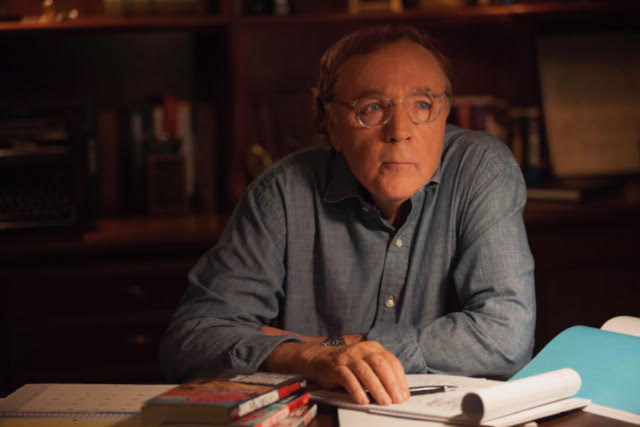
AFG: I wanted to ask you, James, what advice would you have for beginning authors?
JP: Don’t do it. [laughs] You know, there’s no advice—I never give out advice anyway,
man. I have that MasterClass thing and I don’t give advice on MasterClass. I just tell people what I do. And people might find it useful. The only thing—I guess it’s a little bit of advice—I’d say is, anything that you’re nodding your head to, pay no attention to, cause you already do it. The stuff that you’re shaking your head against, that’s the stuff you ought to think about because that’s what you’re not doing. If you’re going to get better, it’s going to be because you change. And if you’re not getting published, it might be because you need to change. It might be. It might just be that publishers are stupid—which sometimes they are. They pass up a lot of stuff. I mean look, they passed up the first Grisham. Pretty much everybody passed on A Time to Kill and that’s one of his best books. I’m very lucky that I got in under the wire and now I’ve been grandfathered. So they kind of have to do my books now. I mentioned this book about dads that I’m doing; the last little chapter is just an add-on chapter, and what I said to these guys—which I think [is relevant] in particular in this day
and age—is, “Write down all the stuff in life that pisses you off. All the stuff that really makes you see red that pisses you off. And now, cross off everything on that list that you can’t do anything about. Just cross it off and get it out of your life. And now the stuff that’s still on the list, do something about it.” So I would give people that kind of advice. But the writing stuff, people have to figure it out. The thing of it is, if you’ve got a passion for it, you can’t help yourself. There are people that have written twenty novels that haven’t been published and they just had to do it. They’ve got to sit down and write another one. And I’m waiting for—I haven’t really heard this—maybe it’s happened already, but where the twenty-first novel got published, and the publisher went back and said, “We’ve got to publish the other twenty because they’re all great.”
For the complete interview purchase issue 73 of the Strand by following this link.