


Unmasking Chandler: What “Nightmare” Reveals About the Writer Behind Marlowe
by Tom Williams
“Nightmare,” by Raymond Chandler, may not have the energy of his best fiction, but it remains a fascinating piece that sheds new light on his early career. It surfaced as part of the Jean Vounder-Davis Collection of Raymond Chandler, sold at auction in late 2024, and includes material that biographers had not previously accessed. Chandler hired Vounder-Davis in January 1957 at a difficult point in her life: living under her married name, Jean Fracasse, she was in the midst of a messy divorce. Chandler himself was still mourning his beloved wife, Cissy, who had died just over two years earlier. He grew close to Fracasse and her children; her daughter Sybil later recalled cutting down the yellow sheets of paper to the size Chandler preferred because it forced him to put “a little meat on each.”
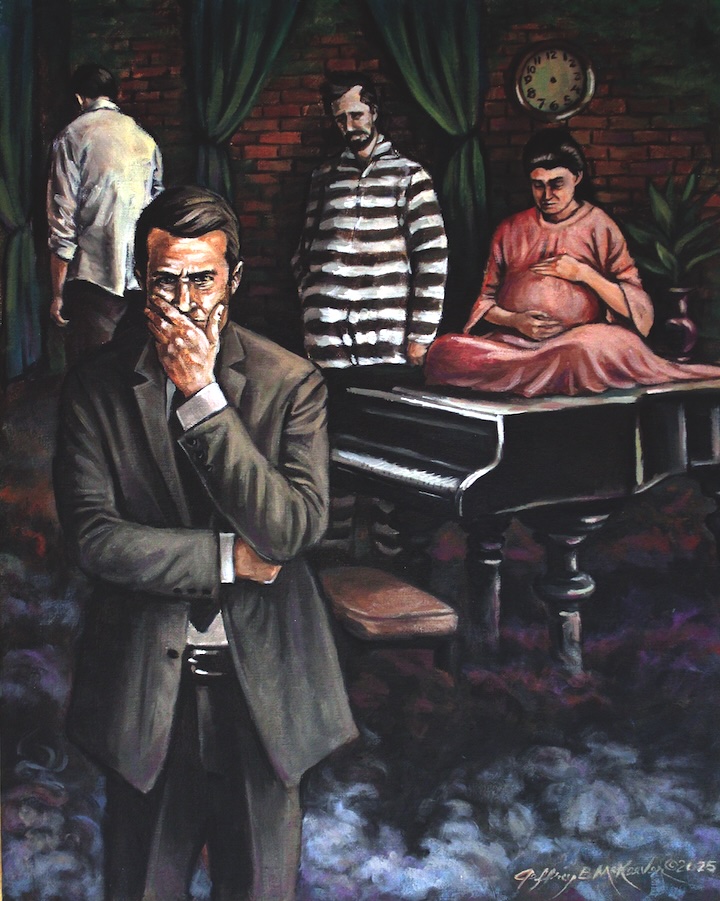 Dating “Nightmare” is challenging. Cissy—who reportedly found the piece “very funny”—was alive when it was written, so it must predate her death in December 1954. Her reaction is characteristic of their relationship: Cissy often shared her opinions. When Chandler outlined three potential novels shortly after The Big Sleep, she added her own dry annotation: “Dear Raymio, you’ll have fun looking at this maybe, and seeing what useless dreams you had. Or perhaps it will not be fun.”
The most revealing line in “Nightmare” is Chandler’s aside: “It will remind me of the days when I used to get returned manuscripts.” Chandler enjoyed mythologizing his own life. In 1933 he told his friend William Lever, “I sold the very first story I sent out.” That was “Blackmailers Don’t Shoot,” published in Black Mask in December of that year. Yet “Nightmare” complicates this account. Did he submit stories to Black Mask before “Blackmailers Don’t Shoot” that were turned down? Or was he thinking back to his early literary ambitions in London, or to the years after the war when he worked in the oil industry?
Chandler had always wanted to write. Before emigrating to America in 1912, he published poetry and journalism in Britain and later admitted to Lever that writing was the only thing he ever wanted “with all my heart to get.” He continued to write poetry and even a libretto after moving to the United States, though little of it circulated beyond his friends. It is entirely possible he made unsuccessful attempts to publish literary work well before turning to the pulps. Only later, in 1931, after losing his oil industry job, did he claim to have seriously considered crime fiction.
Whatever its precise context, “Nightmare” unsettles the neat origin story Chandler liked to tell. It hints at a different, less linear literary trajectory. For all his efforts to craft the legend of a self-invented writer, Chandler remained, even to himself, his greatest mystery.
Tom Williams is a writer and critic based in Washington, D.C. He is the author of A Mysterious Something in the Light: The Life of Raymond Chandler, published in the UK, US, Brazil, and China. His reviews and essays have appeared in The Times Literary Supplement, The Observer, The Irish Times, and The Spectator.