

When Fiction and True Crime Collide: The Lore––and Lure––of Notorious Unsolved Crimes
by Bonnie Kistler
Readers often describe the plots of my novels as “ripped from the headlines.” I prefer to think they were ripped out of my own imagination, but it is true that my books usually touch on topics that are part of the current zeitgeist.
But that’s not true of a key plot point in my latest, Shell Games. Far from being ripped from the headlines, that detail was unearthed from the archives. It resurrects a forty-year old never-solved crime known as the Tylenol Murders.
A quick recap for those who don’t remember or never knew. In 1982, someone visited several stores in the Chicago area, removed what were then easy screw-off caps on bottles of Extra Strength Tylenol, replaced some of the capsules with potassium cyanide, and put the bottles back on the shelves to be purchased by unsuspecting consumers. Seven people ingested the poison and died horrible deaths. Authorities quickly established that the tampering did not take place in the factories or during shipment. It could only have occurred on the store shelves between certain specific dates. A prime suspect was identified, but there was no proof that he was in the Chicago area during that time. He was never charged––in fact, he died last year––and the Tylenol Murders remain officially unsolved.
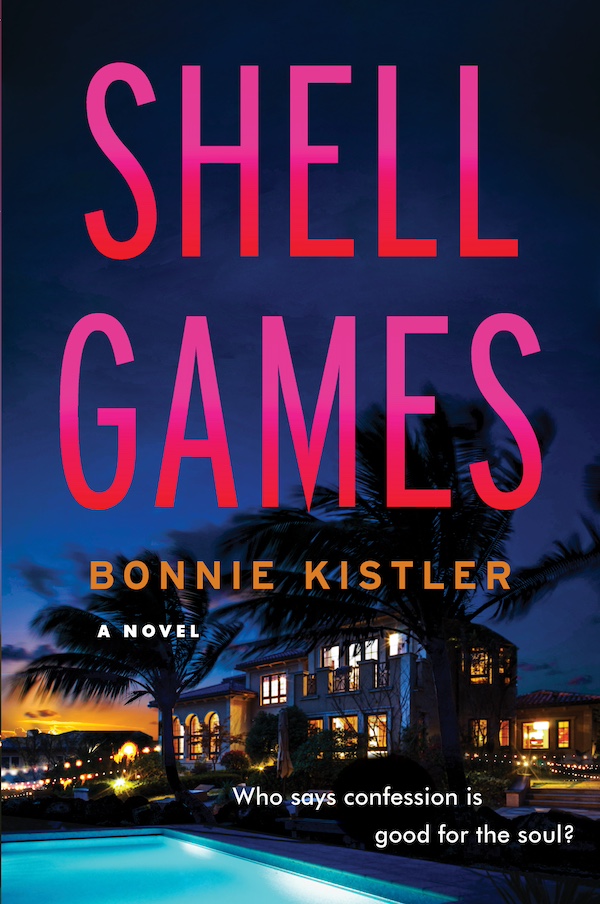
This true crime serves as a launchpad for the events that unfold in Shell Games. Kate and Charlie, once high-school sweethearts, reunite and marry at age 70. She’s a billionaire; he’s a decent and well-liked fellow. The novel opens on their wedding night as Kate calls the police in hysterics, claiming that Charlie just confessed to her that he was the Tylenol killer. He says she hallucinated the confession, blaming the wedding champagne, and the FBI swiftly establishes that he was nowhere near Chicago at the time in question. But Kate insists he did confess. Her daughter is then beset with this question: is her brilliant mother losing her mind, or is her beloved new stepfather gaslighting her to gain control of her fortune? It becomes a shell game, in which the pieces keep shuffling across the table until it’s impossible to guess which shell is concealing the truth.
I’m hardly the only novelist to inject a true crime into a work of fiction this way. Infamous unsolved crimes from real life have featured in the novels of many other writers.
Michael Connelly does this in his new Ballard-Bosch novel, Waiting. Renee Ballard is investigating a couple fictitious cold cases when her new protégé Maddie Bosch starts digging into a real-life cold case, the Black Dahlia murder. In 1947, a young starlet named Elizabeth Short, nicknamed the Black Dahlia, was murdered and dismembered in a grisly crime that’s considered the most notorious unsolved crime in the history of Los Angeles.
James Ellroy first plowed this field in his 1987 novel The Black Dahlia, and there have been numerous film versions, too. In Connelly’s new novel, Maddie Bosch uncovers some new evidence that seems at last to identify the killer. When asked why he chose to insert a real case among his invented ones, Connelly explained that he wanted to tap into the folklore surrounding this infamous crime.
Folklore is a recurring theme when true crime weaves its way into fiction this way. A popular example is the real life case of D.B. Cooper. In 1971, a man using that name hijacked a plane, claimed he had a bomb, and demanded $200,000 and four parachutes. Upon landing in Seattle, he released the passengers, collected the ransom, and ordered the flight crew to fly to Mexico. He parachuted out of the plane somewhere over Washington State. Neither he nor the bulk of the money was ever found.
He most likely died in the fall, but that hasn’t stopped people from speculating about what might have happened to him. He’s been reimagined as some kind of modern folk hero, and just as with the Black Dahlia case, numerous books, TV shows, and movies have fictionalized the case. Prominent among these is Elwood Reid’s novel, D.B. In it, Reid invents a compelling back story for Cooper and imagines that he actually made it to Mexico.
 Perhaps the most notorious unsolved murders of all time are the Jack the Ripper killings. In 1888, in the Whitechapel district of East London, a number of sex workers were murdered and dismembered in a particular gruesome manner. The crimes were never solved, and the legend of the killer dubbed Jack the Ripper completely seized the public imagination. He’s been featured in literally hundreds of novels, short stories, TV shows, movies, and even songs.
One of the most notable works about Jack the Ripper is the 1989 graphic novel From Hell by Alan Moore, which delves deep into the mind of a madman. Considered by many to be the most important graphic novel ever published, From Hellgarnered numerous awards and stands as a terrifying masterpiece of historical fiction.
The Tylenol Murders don’t have nearly the same folklore status as these other true crimes. They lack the gruesome psychosexual aspects of the Jack the Ripper or Black Dahlia cases, and there’s no figure like D.B. Cooper to romanticize. Many people, especially those born after 1982, don’t even remember the Tylenol Murders. Others remember them only faintly, usually while struggling to open a pill bottle. Tamper-proof packaging became mandatory in the wake of these murders.
That generational divide was part of my reason for injecting these real-life murders into the fictional world of Shell Games. Kate, who’s 70, remembers the murders and might easily (and drunkenly) have imagined that Charlie confessed to them. Her daughter, on the other hand, has to google the term to figure out what they’re talking about.
But my larger purpose was to allow this part of the real world to penetrate into my fictional one. I hope that most readers will find their memories stirred at the mention of the Tylenol Murders. That they’ll think Oh, right, I remember that, and Gee, was it really never solved? Others who don’t remember may instead think Wait, did this really happen? Either way, I hope the reference makes Charlie’s supposed confession more intriguing. This real-life event was a heinous crime but not a brutal one and not one that took any great expertise. Almost anyone could have committed it. Even Charlie.
Bonnie Kistler is the author of The Cageand Her, Too, and her new book SHELL GAMES (Harper Paperbacks, 11/18/2024). A former Philadelphia trial lawyer, she was born in Pennsylvania and educated at Bryn Mawr College and the University of the Pennsylvania Law School. She and her husband now divide their time between southwest Florida and the mountains of western North Carolina. For more on Bonnie Kistler, visit:https://bonniekistler.com/
Click here for more blog posts!