

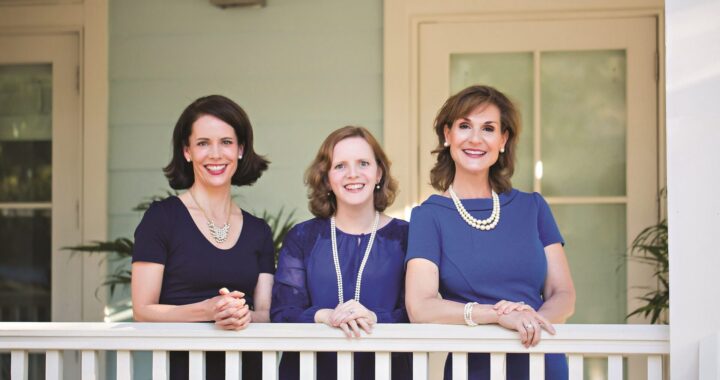
More than a few murders have marked the career of Team W (the writing team of Karen White, Beatriz Williams, and Lauren Willig): there have been skeletons found in Newport, skullduggery on the Lusitania, and, most recently, a male author found murdered multiple ways in a faux medieval castle on an island off the coast of Scotland. But, despite writing five books together, not once have these authors ever contemplated murdering each other. (At least, that we know of.)
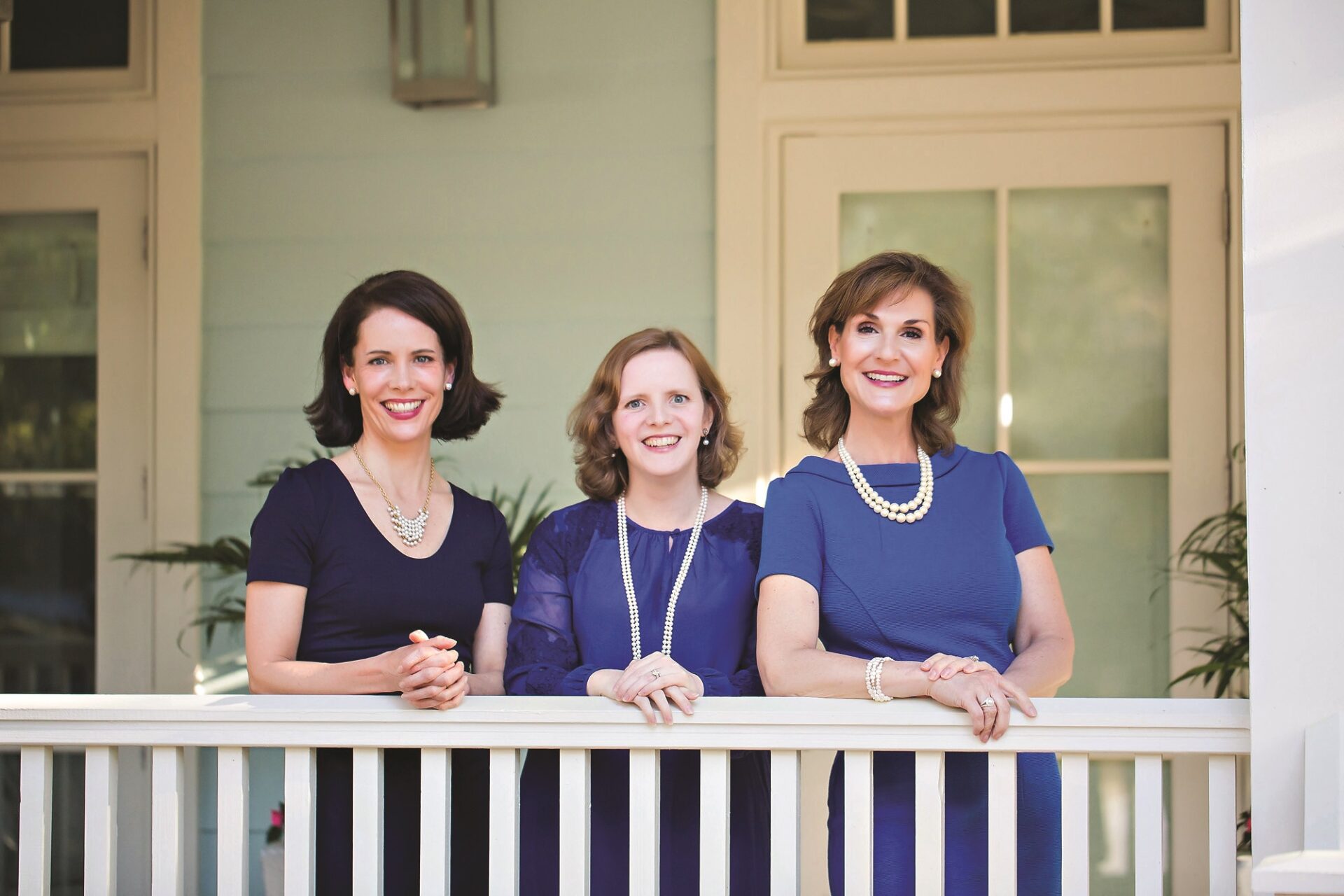
Pictured from left to right: Beatriz Williams, Lauren Willig, and Karen White
When we started out, we’d all written a bunch of books on our own, but none of us had ever co-written a novel. Our aims were modest and few: an ironclad excuse to spend more time together, two weeks on the road together for book tour, and a publisher willing to pay our bar bill. With those goals in mind, we blithely plunged into the project, over the objections of our agents, who reminded us of our individual deadlines, and of our editors, who told us that anthologies don’t sell and seemed baffled when we told them this wouldn’t be an anthology, but a single novel with three authors.
Since we had no idea what we were doing, we invented our process as we went along.We gathered over tea and scones to plot. That plotting session turned into an outline, and that outline turned into the book that became the New York Times and USA Today bestseller The Forgotten Room. It was all so seamless that we assumed co-writing always worked like this. Until two things happened to disabuse us….
During our kickoff event on that long-anticipated book tour, when we opened the talk for questions, a hand shot straight into the air. “How do you resolve conflict?” the reader wanted to know. We looked at each other in confusion, because, really, there hadn’t been any conflict, other than Karen only drinking red wine, and Beatriz sometimes wanting white wine—to which, of course, the answer always was to order Prosecco. Problem solved. Nonetheless, that question followed us from tour stop to tour stop, the assumption being that where there are multiple creative types, there must be friction.
This struck us a lazy stereotype, until one or two members of Team W—to remain unnamed—decided that since our collaboration was so smooth and friction-free, why not collaborate with other authors to create even more bestsellers? Spoiler: it was not a great idea. In stark terms, we understood that conflict question a whole lot better—and that what the three of us had was really something special.
How do you write collaboratively without conflict? Well, first you stock up on Prosecco, obviously. But here are our other tips:
There is no “I” in “our”. We meet up and plot the entire book out together. We never remember whose idea was whose, or who experience that initial flash of inspiration that led to a book. It might have come from one of the five thousand Daily Mail articles Beatriz likes to share on the Team W text chain, or one of the true crime podcasts Karen listens to as she drives to book talks, or a fun historical tidbit Lauren just couldn’t resist passing along. Within five minutes, that original inspiration will have been transformed beyond recognition by a barrage of “what if” and “yes—and!”
Never say no. It’s a Team W truism that none of us ever says no (although, really, sometimes we should—just not to each other!). It’s always, “yes—and!” Instead of shooting down ideas, we grab them and build on them. As in, “What if we three authors were only pretending to be besties?” To which the response was, “Yes, and then someone is murdered and they’re all suspects!” Followed by, “Yes, and then the sheep solves the crime!” Okay, maybe not that last bit, although we did still get a sheep in there on the crime scene.
Check your ego at the door. We wouldn’t be human if we didn’t have moments of “wait, but I liked that idea better” or “huh, that’s not how I would have written that”. We all have different voices and different writing styles and different backgrounds and experiences—but that’s part of what makes our collaborations work so well. Taking a deep breath and really listening and thinking makes all the difference in the world. Because the joy of co-writing—one of the many joys of co-writing—is that co-authors have things you don’t to bring to the manuscript.
Trust is key. It’s knowing your co-authors are talented professionals who know what they’re doing. It’s knowing that they have your back and will tell you if your work sounds like a monkey has been tap-dancing on your keyboard. It’s knowing that everything said in the endless group text chain will stay in the endless group text chain— or at least until the heavily redacted twenty volume set is released after our deaths, co-edited by our daughters. It’s knowing that at least one person will remember which hotel we’re meant to be staying in when we land in a strange city at three in the morning.
There is one exception to all this togetherness: we don’t edit one another’s chapters unless we’re invited to do so. We all go through the complete manuscript to ensure continuity and catch typos (three sets of eyes are better than one!) and just because it’s a joy to reread the whole thing all in one go, but we will not touch each other’s prose unless someone explicitly says, “Hey, this section isn’t working for me—help!”
Give each other grace. Authors are people. We all have families, obligations, and days when we just don’t feel so fresh. Picking up the slack for each other without resentment and without keeping score is part of what make it all work. When you’re the one taking one for the team, you know that another member of the team will do the same for you when you need it, no questions asked.
In The Author’s Guide to Murder, we took our origin story and turned it on its head. Cassie, Emma, and Kat might claim to be besties, but from the moment they burst on the scene, bickering, it’s clear that their professions of friendship are purely for Instagram. But, you know what? If they can figure out how to work together, so can anyone. Go on, give it a try, we dare you.
Just stay away from remote Scottish castles and inquisitive sheep. And, when in doubt, always order the Prosecco.
ABOUT THE AUTHORS:
Beatriz Williams is the bestselling author of over a dozen novels, including Husbands and Lovers, The Summer Wives, and The Secret Life of Violet Grant, as well as four other novels cowritten with Lauren Willig and Karen White. A native of Seattle, she graduated from Stanford University and earned an MBA in finance from Columbia University. She lives with her husband and four children near the Connecticut shore, where she divides her time between writing and laundry.
Lauren Willig is a New York Times and USA Today bestselling author of more than twenty-five novels, including Band of Sisters and the RITA Award winning Pink Carnation series. An alumna of Yale University, she has a graduate degree in history from Harvard and a J.D. from Harvard Law School. She lives in New York City with her husband, two young children, and vast quantities of coffee.
Karen White is a New York Times and USA Today bestselling author of thirty-four novels, including The Last Night in London and The House on Prytania, as well as the Tradd Street mystery series. She currently writes what she refers to as “grit lit”—Southern women’s fiction. She is a graduate of the American School in London and has a BS in management from Tulane University. When not writing, she spends her time reading, singing, and avoiding cooking. She has two grown children and currently lives near Atlanta, Georgia, with her husband and a spoiled Havanese dog.