

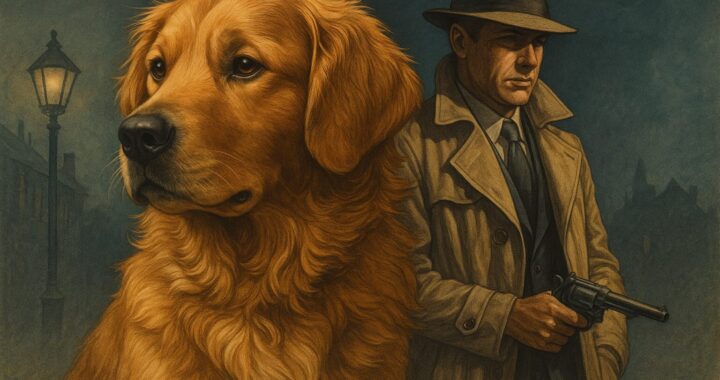
A DETECTIVE’S BEST FRIEND: Presenting A Pack of Six Crime Fiction Canines
by Dick Lochte
Canines are not only humankind’s best friend, but they also star in several mystery novels. Dick Lochte gives us a round up of all fabulous Fidos, in his article A DETECTIVE’S BEST FRIEND: Presenting A Pack of Six Crime Fiction Canines.
The history of mystery fiction is filled with nearly as many sidekicks as there are sleuths. Some are clever, some dull. Some are foolish, some substantial. But only one type offers unconditional love, instinct and, quite often, the ability to sniff out evil. The noble, loyal dog has assisted in the pursuit of criminals through the pages of suspense literature for many decades, from the shadowy, fog-shrouded moors and alleys of Victorian London to the sunbaked mean streets of contemporary Los Angeles.
No surprise then that my co-author Wiliam Webster and I decided that the hero of our thriller, Rockets’ Red Glare, Wind River Tribal Police Deputy Sage Mendiluze, needed a four-legged partner to assist him in tracking down a pair of assassins on a homicidal rampage through this country’s national parks. In crafting Peak, our faithful, adventurous pooch, we understood that the ultra-protective five-year-old Australian shepherd, though in our opinion the best in show, would be the descendant of a long line of crime fiction canines. That list includes …
SIR ARTHUR CONAN DOYLE’S TOBY
One of Peak’s earliest ancestors is literally a bloodhound, Toby the detective dog introduced in Doyle’s second Sherlock Holmes novel, The Sign of the Four. The complex plot involves a decade-old disappearance, a map to hidden treasure from India, twin brothers, murder by poisonous thorn, and two killers, a one-legged man and his Indian islander cohort. In need of a tracker to follow the assassins, Holmes turns to Toby, described as an animal possessing the ability to “follow (a) scent to the ends of the earth.” That’s all Holmes asks of him, dependability and unerring instinct, as focused, and unswervingly loyal to the task as is his temporary master.
Toby is not the only cur trotting through the Holmes canon. The story “The Adventure of Silver Blaze,” features “the dog that didn’t bark,” a “curious incident” that helps to solve the crime. And, of course, there is arguably the most famous Holmes novel, The Hound of the Baskervilles, in which the great detective and his human sidekick, Dr. John Watson, travel to Devonshire to stop the murder of Sir Charles Baskerville. But there may be a more homicidal creature on the foggy moor than the infamous hound. (Those seeking a more unequivocally murderous mutt, should try Stephen King’s rabid St. Bernard Cujo.)
DASHIELL HAMMETT’S ASTA
Bounding ahead to 1930s America and Hammett’s last completed novel, The Thin Man, we find its happy, hard-drinking couple, ex-private detective Nick Charles and his heiress wife Nora, with a scrappy little dog named Asta. In the book, she’s a female schnauzer, used predominately to give the Charles’ flamboyant lifestyle a hint of normalcy, even if the charmer is a bit rambunctious. “She had a wonderful afternoon,” Nora tells Nick, “knocked over a table of toys at Lord & Taylor’s, scared a fat woman silly by licking her leg in Saks’s, and been patted by three policemen.”
The movie Asta, as portrayed by a much better-trained dog actor named Skippy, was transformed into a male Wire Fox Terrier. The furry little performer was used so successfully as comedy relief in the ensuing film series — especially notable is the scene in the sequel After the Thin Man when Asta discovers that Mrs. Asta has been unfaithful — that the character turned iconic and Skippy became one of the most famous and highly paid dogs in Golden Age Hollywood.
ROBERT B. PARKER’S PEARL THE WONDER DOG
Another popular literary canine used for purposes other than detection is Boston PI Spenser’s Pearl, a German shorthaired pointer who was a barely fictionalized version of the author’s own Pearl. She becomes a main character – the “child” shared by the sleuth and his significant other, Susan Silverman — in the eighteenth entry in the series, Pastime. This novel, considered among the best of the Spensers, is actually a sequel to Book 7, Early Autumn, written a decade before, in which the detective saved a teenage boy from his abusive father. That boy, now in his twenties, wants Spenser to find his mother who has gone missing after an involvement with criminals. In the course of the investigation, Parker provides a fair amount of his hero’s long-missing personal history. And he paints an appealing portrait of the lovable Pearl who remains a fixture until Book 29, Widow’s Walk, when old age has left her slow-moving and frail. In the following series entry Back Story, she is succeeded by Pearl 11, an untrained puppy who, like the original, continues to symbolize the hardboiled sleuth’s softer side, acting as a reminder that in the author’s moral universe justice requires compassion beneath the bravado.
ROBERT CRAIS’S MAGGIE
Crais’ main sleuth, Elvis Cole, essentially a younger West Coast version of Spenser, is more cat- than dog-lover, but in the novel, Suspect, another of the author’s protagonists, LAPD K-9 officer Scott James walks his beat with Maggie, a retired military German shepherd. She is suffering a canine version of PTSD caused by the death of her handler and her own wounds after a bombing attack in Afghanistan. Scott himself has not quite recovered from a devastating ambush by unidentified assailants who killed his human partner. Just as in Rockets’ Red Glare, after Sage and Peak are nearly killed by explosives left by the assassins, the bond between man and dog is more than mere companionship—it’s one of healing.
Crais writes some of the novel from Maggie’s point of view, displaying astonishing empathy while allowing readers into her memory-driven, sensory world. In this Maggie clearly is not just a sidekick or emotional support; she’s a protagonist. Though the crimes she helps solve are important, they’re secondary to the deeper story: two wounded souls rebuilding by trusting one another. (Further examples of novels that take readers into the minds of dogs include Spencer Quinn’s Chet and Bernie series, narrated by Chet the canine partner of Bernie the down-at-heels private eye, and several of Dean Koontz’s bestselling fantasies, including Watchers which features Einstein, a genetically altered golden retriever who understands human language and has near-human intelligence.)
DAVID HANDLER’S LULU
In his first witty, smoothly constructed mystery involving celebrity ghostwriter Stewart “Hoagy” Hoag, The Man Who Died Laughing, Handler was wise enough to provide his amateur detective with a faithful brown and white basset hound as charming, sophisticated and observant as her master. Hoagy’s career has had its ups and downs. After penning a popular and critically successful first novel, he suffered a writers block severe enough to cause cocaine addiction and the loss of prestige, money, friends and wife. Everything but the loyal Lulu who, with her waspish manner, odd penchant for foul-smelling food and seemingly miraculous manner of sniffing out evil, became a grounding presence for Hoagy. When the former bestseller settles for the inglorious hybrid profession of ghostwriter and amateur detective, Lulu becomes a unique sleuthhound in her own right.
The duo’s current adventure, The Man Who Swore He’d Never Go Home Again, is a series prequel, with freshly successful first novelist Hoagy returning to his small hometown in Connecticut for a funeral. In it we meet his new puppy Lulu and his new girlfriend (and eventual wife and ex-wife) actress Merilee Nash and learn how they all got together. Because of this, it’s a good starting point for the uninitiated, but, though entertaining, it’s not quite as satisfying a crime novel as his Edgar-winning The Man Who Would Be F. Scott Fitzgerald or last year’s elegant The Woman Who Lowered the Boom. That has Hoagy on the cusp of regaining his status as a rockstar novelist and doubly buoyed by the possibility of remarrying Merilee. Happiness at the start of a mystery must of necessity be short-lived and, just a few pages in, Hoagy learns that his editor, Norma Fives, has received letters threatening her life and, by extension, his novel. What can he do but expose the anonymous author of the letters and what can Lulu do but suffer the loss of comfort and a plate of her beloved sardines while helping him on the hunt?
DAVID ROSENFELT’S TARA
A unique mixture of cozy comfort and hard-edged action, Rosenfelt’s novels—particularly the series featuring reluctant defense attorney Andy Carpenter —are suffused with canine affection. The author, himself a dog rescuer, populates these humorous mysteries with an ever-present cast of lovable canines, most often led by Tara, a charismatic golden retriever modeled after Rosenfelt’s own late Tara. Like the other dogs in Andy’s world, Tara doesn’t usually chase down criminals or sniff out murder weapons. Instead, as is evident in 2023’s ‘Twas the Bite Before Christmas, when Andy dog sits for a client and Tara is joined by a second retriever, she provides not only humor but, more important, a steady moral compass. Human anger and avarice may drive the plot, but Tara and her pals provide the ethos: loyalty, love, and the simplicity of doing the right thing.
In these examples, the dogs are more than pets. Their very presence humanizes and balances the cynicism of the crime genre. Whether they’re bloodhounds, retrievers, or, as in our novel an Australian shepherd, these literary dogs act as extensions of their human counterparts, reflecting fears, hopes, traumas, and moral centers. They do not lie, they do not betray, and they are never morally gray. This is why we so often find them at a detective’s side – in the fictive mystery’s shadowy world, with its liars, cheats and secret psychopaths, a dog is the one character we can trust.
Dick Lochte is the co-writer with William Webster of Rockets’ Red Glare, an action thriller arriving May 20, from Blackstone Books. Along with a journalism career that includes several decades as a contributing columnist to The Los Angeles Times’ Book Review and Los Angeles magazine, Lochte has written films, numerous short stories and fifteen novels, among them the prize-winning mystery Sleeping Dog. He lives in Southern California with his wife Jane and their dog Hoagy, a tan and white Australian Labradoodle as loveable as the day is long.
If you enjoyed this article about A DETECTIVE’S BEST FRIEND: Presenting A Pack of Six Crime Fiction Canines, we have an interview with David Handler who created wonderful Lulu.