

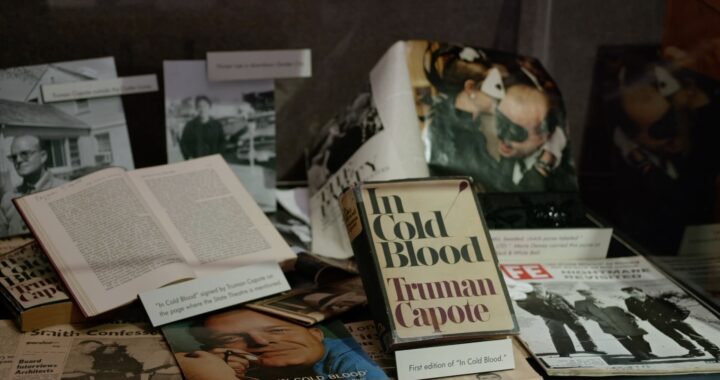
Truman Capote and the Murder of Holcomb: An Interview with Filmmakers Julien Gaurichon and Frédéric Bas
By Thomas Fahy
(We are proud to present this exclusive interview with Julien Gaurichon and Frédéric Bas)
The centennial of Truman Capote’s birthday, September 30, 1924, offers another opportunity to
think about his legacy as a writer and celebrity. His masterpiece In Cold Blood (1966) continues
to captivate readers and spark debate about the lines between fiction and fact, art and
exploitation. He immersed himself so deeply in the lives of killers Perry Smith and Dick Hickock
that their deaths, which eventually became necessary for the completion of the book, put Capote
on a self-destructive path that prevented him from completing another novel.
French documentary filmmakers have tackled the complexity of this work and Capote’s
involvement in the case in their upcoming documentary Truman Capote and the Murder of
Holcomb. The film, scheduled for release in France and Germany next month, includes
interviews with forensic investigators, actress Brenda Currin (who played Nancy Clutter in
Richard Brooks’ 1967 adaptation), a museum curator in Holcomb, writers, and historians. I had
the opportunity to talk with them about the project and about the challenges of making a film
about such an iconic text.
Thank you both for taking the time to speak with me. I want to start by asking a little
about your background as documentary filmmakers. What inspired your interest in
documentary?
Julien Gaurichon: I’ve been making documentaries for about twenty years now. One of my most
memorable television adventures was being part of a team headed by Serge Viallet, who is a film
director for a documentary series entitled Mysteries in the Archives. This documentary series was
coproduced by the French National Audiovisual Institute and the French/German television
channel Arte. It was conceived as a documentary series to uncover or rediscover footage that
bears witness to a century of history. Each episode focuses on a widely known image, such as the
first steps on the moon, and it examines that historical moment through the image. The series has
been broadcast in many countries, and it includes sixty-five films to date.
Frédéric Bas: Julien and I met during our service in the French Army in 1997. We were on a film
unit assigned to examine the film archives of the military since World War II. I had been a
history student for six or seven years before this, and I loved exploring and examining this
footage. Our first documentary film focused on American singer-songwriter Willy DeVille. He is
not as well-known in the United States as in France, though his song “Storybook Love” was
nominated for an Academy Award for the film The Princess Bride. We went to New York to film
it, and even after we finished, we weren’t sure we had a film. I said to Julien, “We have a friend,
but we may not have a film.” Our first opportunity to do a television documentary was for the
series Duels of History for France 5 TV. That was a film about the relationship between Malcolm
X and Martin Luther King.
Julien: Exactly right. We were interested both in the way Malcolm X and Martin Luther King, Jr.
used the media to communicate their messages to the public and in the way the media chose to
represent—and in many cases—misrepresent them. Their public rivalry forced us to question the
strategy and tactics used by the media.

What inspired your latest film on In Cold Blood?
Julien: It came out of several discussions with the team at Arte. We were talking about important
works—books and films—that marked eras and became significant cultural landmarks, and our
producer, Carine Ruszniewski, and Karen Michael, who is a co-director of the cultural programs
at Arte, encouraged us to make a film about a text. The idea was to examine it from a social,
cultural, and artistic perspective. Almost immediately, Fred and I decided to focus on In Cold
Blood. Truman Capote’s creation of the “nonfiction novel,” as he called it, offered a new
approach to true crime, and the book has served as a model for true crime writers and journalists
ever since.
Frédéric: In France and the United States, there are a lot of films, novels, and journalistic
accounts of true crime. Our idea with In Cold Blood was to use it as a way to think about the
genre of true crime more broadly. Carine was enthusiastic about the idea, and we thought that
this film would be a great way to begin a season largely about true crime. Some of the other
episodes this year will focus on the Jean-Claude Romand affair and the amazing book My Friend
Dahmer about Jeffrey Dahmer. The goal of each episode is to think about the impact of true
crime on the writers and filmmakers who deal with this subject.
Julien: What interested us with In Cold Blood, if I may add, was the prospect of portraying an
artist who was consumed by his creation. It engulfed him, and in many ways, it destroyed him.
There have been so many films and so many discussions about In Cold Blood.
What were some of the challenges of taking on this project? How did you add your own spin to this well-known story?
Frédéric: First, we were interested in the line between fact and fiction. We wanted to show
French audiences what Capote meant when he claimed to invent a new literary genre. What does
one make of his assertions about accuracy? How did he blur the line between truth and fiction?
Despite Capote’s claims, we wanted to use archives, papers, and drawings to explore the ways
Capote crafted this story. Second, we wanted to examine the decline of Capote after this book. A
great sadness came over him with the completion of In Cold Blood. The emotional effect of those
years in Kansas is just as important as the professional achievement of the novel.
Julien: With this question, I suspect you have in mind Bennett Miller’s masterful biopic Capote
(2005). This film really introduced large audiences to Truman Capote’s tragic involvement in this
case. His strange relationship with Dick Hickock and Perry Smith, the two murderers of the
Clutter family, arguably brought him too close to the darkness of this crime. We wanted to
explore this from a documentary perspective by filming and interviewing historians and writers
who have tried to understand the contradictions and ambiguities of the character of Truman
Capote. We wanted to incorporate these perspectives, particularly the kind of historical analyses
in books like your Understanding Truman Capote, to better situate this work in the 1950s and 1960s
American culture.
Frédéric: You say that In Cold Blood is a very familiar story, but in France few people have read
Truman Capote. Certainly, the film Capote brought a lot of attention to Capote in France, making people wonder about his fame. We wanted our documentary to go beyond the legend of Capote,
as captured by the immensely talented Philip Seymour Hoffman. We tried to use archives and
interviews to show the real Capote, to show the man who became exhausted and overwhelmed
by the project. In Cold Blood is, of course, a story of the death of six people, but we propose that
it is about the death of seven people. Capote became a character in this story and, ultimately, its
seventh victim.

I also wanted to ask about your experiences filming on location, particularly in Kansas. Did
that change your perspective or your approach in any way? What was it like spending time
in Holcomb?
Julien: Kansas really inspired us. We discovered the studies of Travis Linneman, who is a native
of Kansas and featured in the documentary. He discusses the ghostly presence of that book on
Holcomb today. In Cold Blood is still alive in that space, hovering around the town, and this
haunting aspect of the story interested us. We also found the town to be utterly exhausted by the
interest in In Cold Blood. They can’t stand it anymore. It has been a poison to them, so it
was a challenge to convince people close to the current owners of the Clutter house to permit us to shoot there. We actually went to the only restaurant in town, a Mexican restaurant called El Rancho, with a bottle of Bordeaux to persuade the owner, Nancy to help us get that
permission.
Frédéric: Yeah, yeah.
Julien: But most people don’t want to talk about it. They are fed up.
Frédéric: Julian and I felt a bit like Capote when he first went to Kansas in 1959. We were not
there for the crime and the impact of the crime on Holcomb. We were there for the impact of the
book on Holcomb. Most of the people we met don’t like Capote very much, and many refuse to
read the book. It is too personal for them. The people of the town were very affected by the
deaths of the Clutter family, and they still speak of the family with great respect. We quickly
realized that there were things we simply could not ask them. We could not ask them to speak
about Perry Smith and Dick Hickock, about the nature of the crime, or their relationship
with Capote.
A few moments ago, you talked about In Cold Blood as responsible for seven deaths. It
seems as if you could argue that it was responsible for eight deaths—the death of Holcomb,
a town devasted by Capote’s book. As Julien says, it still haunts them. It still maintains a
ghostly presence that is not welcome. It has become fatiguing for those who still live there.
Julien and Frédéric: Absolutely.
As storytellers and artists, we have to be flexible with our projects. We have to give them
room to breathe and take us in directions that we don’t always expect. What were some of
the unexpected moments and discoveries that you made along the way that changed the
direction of the film?
Julien: One of the most difficult tasks was covering all this material in a fifty-two-minute format
for television. There were so many different narrative threads. We knew we had to handle the
criminal case and its various protagonists. We knew we had to introduce them to a French audience largely unfamiliar with them. We knew that we had to introduce the story of the
investigation, the research in the field, the writing of the book, and the tragic journey of its
aftermath for Truman Capote.
Frédéric: There were lots of practical difficulties as well. In many television documentaries, there
is a person on a couch talking about what they know. Julien wanted to make the guests and
speakers characters. For example, the scene in Central Park when we filmed you reading the
book is, for me, one of the most beautiful moments in the documentary. We didn’t know if it
would work. We didn’t know our way around New York very well, and Julien found this bench
using Google Maps. It was late and dark, and we had no idea how it would turn out.
Julien: To go back to the question about what surprised us, I would say it involved the question
of truth. When we first started researching the project, we believed what Capote was saying
during interviews. He often claimed that one of the biggest innovations of In Cold Blood was
that he never appeared as a character or narrator. But that was just a magic trick. He is
everywhere in In Cold Blood. We can feel his ghostly presence hovering over every page,
situation, and character as if with a sorcerer’s eyes. We wanted to make this sorcerer’s eye more
visible to our audience in our documentary.
Finally, how did making this film change your relationship with the book and Truman
Capote himself?
Julien: This masterpiece took six years of his life, and it became just as much an exploration of
himself as it did of the killers and the Clutter family. The deeper I go into this book, the more I
think of the way Capote viewed himself. All of those years immersing himself in these murders
… it revealed disturbing truths about himself. The book must have been like a mirror for Capote,
reflecting something that frightened and horrified him—particularly in his emotional closeness with Perry. Capote lost his way. He lost himself in the friendship and love he had for that man.
He saw a kinship in Perry’s passion for poetry and music, and there must have been some part of
Capote that worried about his own potential to turn out just like Perry. At some point, I
think he saw the trick and perhaps even saw something monstrous in himself.
Frédéric: I think we also learned a great deal about life and art. On one hand, you have Capote,
the literary genus. He has an extraordinary eye and voice. On the other hand, the real lives and
losses in this case became too much for him. The death of that family and his friendship with
Dick and Perry became too much. For me, the book reveals Capote’s fragility. He gave too much
of himself to his art. There has to be a balance between life and art, and Capote lost that balance.
He went too far. The story was too dark, too tragic for him. Ultimately, this project caused him to
self-destruct, and In Cold Blood is a portrait of that self-destruction.

Julien Gaurichon has been making films for television for about twenty years. He is a
co-director of the documentary series Mysteries in the Archives, which focuses on the history of
images that have marked our collective memory. Truman Capote and the Murder of Holcomb is
his fourth film made in collaboration with Frédéric Bas.
A historian and a teacher, Frédéric Bas has been making documentaries for radio and television
since 2001. In 2020, he directed a short fiction film, L’inspection, which was selected for
numerous festivals.
Thomas Fahy is a professor of American literature and creative writing at Long Island
University, Post. He has published nineteen books, including Understanding Truman Capote and
the forthcoming The Life of the Author: F. Scott Fitzgerald.
For more interviews, click here!